AI is here.
That sentence does not need to be treated like breaking news anymore. It is not a prediction. It is not a trend report. It is not something waiting for permission to become part of work, leadership, learning, creativity, operations, or everyday life. It is already here.
The question is not whether AI will matter. It already does.
The question is whether people will learn how to use it in a way that protects their judgment, expands their capacity, and keeps them from being buried under tools they never learned how to harness.
That is the gap.
The gap is no longer just access. The gap is capacity: knowing what to do with the tools now available.
Access means the tool is available. Capacity means you know where it belongs, when to use it, and what judgment still has to stay human.
Resistance Is Understandable. It Is Also Not a Strategy.
A lot of smart people are still standing at the edge of AI waiting for the right moment to engage. Some are skeptical. Some are tired. Some are overwhelmed by the speed of it. Some tried one prompt, got a generic answer, and decided the whole thing was overhyped.
That reaction makes sense.
Most people were handed AI with no real instruction. They were told it was powerful, disruptive, dangerous, revolutionary, or inevitable. But very few were shown how to use it in the middle of a normal workday, with real responsibilities, real decisions, real time constraints, and real human stakes.
So they either avoid it or use it without a clear system.
They ask vague questions. They accept generic answers. They use it like a search bar, a writing assistant, or a shortcut machine. Then they wonder why it does not feel transformational.
AI is not magic. It is leverage. And leverage only helps when you know where to apply it.
“AI does not replace human intelligence. Used well, it protects it from being wasted on the wrong work.”
The Leadership Shift
Leading into AI does not mean becoming obsessed with every new tool. It does not mean automating everything. It does not mean replacing human thinking with machine output.
It means getting clear on what AI can carry and what humans must still own.
There is work AI can help carry: summarizing, structuring, comparing, drafting, reframing, pressure-testing, organizing, pattern-finding, and turning messy input into usable next steps.
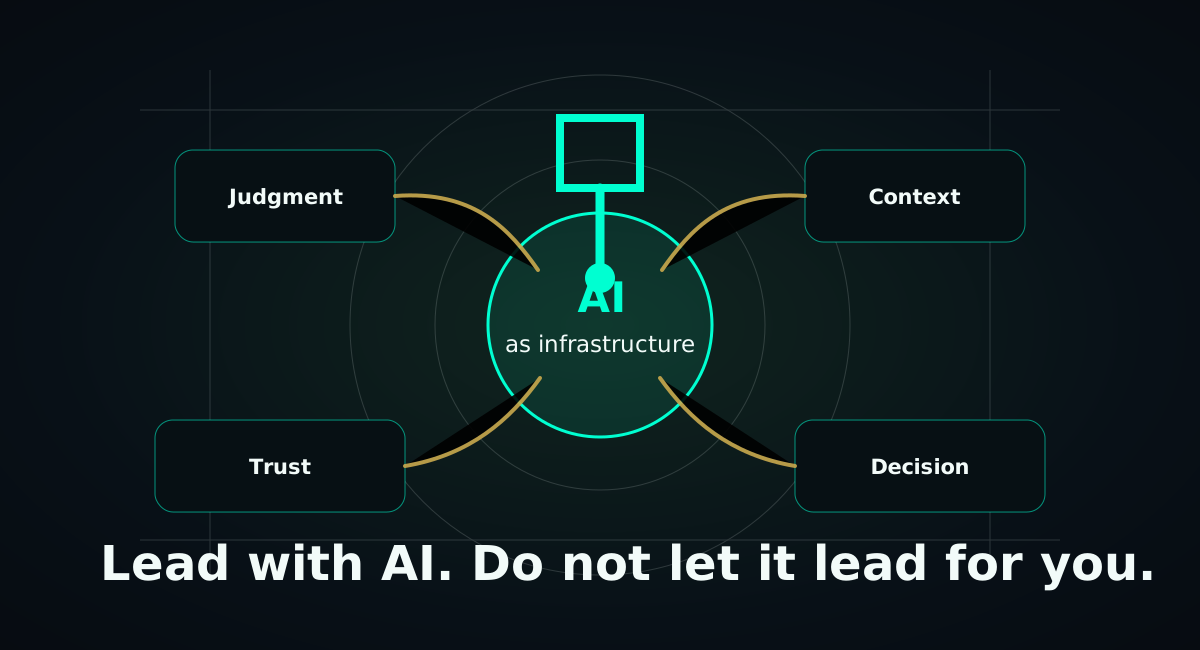
There is work humans must still own: judgment, ethics, relationships, taste, trust, context, accountability, courage, and the final decision.
The professionals who will lead well in this next chapter will not be the people who hand everything to AI. They will be the people who know what not to hand over.
That distinction matters.
AI can give you options. You choose. AI can draft language. You decide whether it is true. AI can surface patterns. You bring context. AI can reduce the blank page. You bring the standard.
The future does not belong to people who stop thinking. It belongs to people who use AI to think better.
The Three Postures Toward AI
Most people are operating from one of three postures.
Avoidance
“I do not want to deal with this yet.” It feels safe in the short term, but it slowly widens the gap between the work you are doing and the work the world is moving toward.
Overuse
“AI can do everything.” It looks innovative, but it often produces shallow work, weak judgment, and a dangerous loss of ownership.
Disciplined Use
“AI can carry the right parts, but I still own the thinking.” This is the posture UnLocked is built around.
Disciplined use is not slower. It is stronger. It helps you reduce the overwhelm without surrendering the part of the work that makes you valuable.
The Prompt That Builds Your AI Operating System
If you are not sure where AI belongs in your work, do not start by asking which tool to use. Start by mapping the work.
Before choosing a tool, name the work. What repeats? What drains you? What requires judgment? What could be structured before it reaches you?
Use this when you need a first move, not a full operating system.
“I want to use AI wisely in my work without outsourcing my judgment. Here is what my role requires: [describe your responsibilities, recurring tasks, decisions, meetings, and pressure points]. Help me identify: (1) the work AI can help carry, (2) the work I should never fully outsource, (3) the places where AI could reduce overwhelm or create capacity, and (4) the first workflow I should test this week. For that workflow, explain what I should give AI, what I should review myself, and what final decision should stay human.”
This prompt does something important. It makes AI practical.
Use this as a map, not the whole operating system. Capacity, UnLocked gives you the complete set of workflows, examples, and use-case-specific prompts so you can turn one experiment into a repeatable way of working.
Instead of asking, “How should I use AI?” you are asking, “Where does AI belong inside the work I already do?” That is the difference between curiosity and capability.
What Leading Into AI Actually Looks Like
It looks like using AI before a meeting to clarify the real decision on the table.
It looks like using AI after a meeting to turn messy notes into owners, deadlines, and risks.
It looks like using AI to pressure-test a strategy before you present it.
It looks like using AI to prepare for a hard conversation, but still having that conversation yourself.
It looks like using AI to reduce the mental load of starting, sorting, and structuring, so your human intelligence is available for the work that actually requires it.
This is not about becoming more technical. It is about becoming more intentional.
The people who will be left behind are not necessarily the people with the fewest tools. They are the people with no system for using the tools they already have.
The Standard Is Not More AI. The Standard Is Better Work.
The goal is not to use AI for the sake of using AI.
The goal is to make better decisions, write clearer messages, prepare more thoughtfully, learn faster, reduce unnecessary friction, and create enough capacity to operate at the level your life and work actually require.
That is why UnLocked does not teach AI as a gimmick or shortcut. It teaches AI as a practical system for creating capacity.
AI can be the key, but human judgment decides what gets unlocked.
When used poorly, AI creates more noise. When used wisely, it gives people room to think, decide, and lead with more clarity.
Start Here
Do not try to transform everything this week.
Pick one recurring point of overwhelm. One meeting you dread preparing for. One decision that keeps circulating. One task that takes more energy than it should. One place where you keep starting from scratch.
Run the prompt above. Test one workflow. Use it three times.
That is how capability grows. Not through hype. Not through fear. Through repeated use that gives capacity back.
This is what UnLocked exists to do: turn access into capacity, protect human intelligence, and reduce the overwhelm. AI is here. The work now is learning how to lead with AI without letting AI lead for you.
Build the system with Capacity, UnLocked.
If this article helped you see where AI could carry real work, the full Capacity, UnLocked playbook gives you the workflows, examples, and prompts to turn one experiment into a repeatable way of working.
Explore Capacity, UnLocked →